Showing posts with label perspective. Show all posts

Sep 29, 2012

Comparison of Lifestyle

Just thought I would summarize a lot of research I've done for this blog (some entries haven't been made yet, they are in draft). You pick which lifestyle you have, and maybe you can get some advice from the ramblings of my mind...and the research I've turned up.

I've decided that there are 3 basic types of lifestyles out there and I'm going to share MY perspectives about them. Again, these are MY perspectives, so don't waste time telling me that I'm wrong just because YOUR perspective may be a little different from mine. Know also, that I am a bit of each of these, depending on my mood that particular day, the experience I am having, and what amount of time I have to expend.
  • Efficient - defined on Dictionary.com as "performing or functioning in the best possible manner with the least waste of time and effort." My perspective: very busy people (work, school, family, hobbies, etc), that strive to be efficient in experiencing life by simply purchasing objects or hiring others to do the personal projects because they don't have a lot of time or experience.
  • DIY - My perspective is that they too are busy people, but strive to experience life by using some of their time & skills as a hobby to save money to create what they want, and will solicit friends to assist if needed on a personal project.
  • Hippie - My perspective is that they stay busy by floating through life by finding ways to recycle things they use, collect, and obtain; which is inspired by the things that sift through their minds, how they can use them, give life to something, is a "green way" to live, and yet also reduces the costs of their out-of-pocket costs.
So, what am I "really" getting at in this entry. I had to explain some things, so you can understand the table below, where I share a topic and then compare how each of the 3 will deal with it, IMHO. If the entry is a link, it is to an entry on my blog about it. Yeah, I've lived through this...

Topic EfficientDIYHippie
Colored flames in the fireplace Duraflame Colorlog DIY Colored PineconesNewspaper Logs & Colored Pinecones
Reduce costs due to cooking Eat out more!!!Use a Toaster Oven & Crock Pot vs. a Full Oven  Hobo Pies in the backyard, Newspaper Logs & Collected Firewood
Driving Limo!!!Carpool & work localWalk, ride bike, or work at home
Stay warm in winter Fire up the furnace!!!Set thermostat to the recommended settings & layer up a littleSet thermostat to the recommended settings, layer up a little, find a Snuggle Buddy
Stay cool in summer Warp drive on the A/C all the time!!!Set thermostat to the recommended settings Set thermostat to the recommended settings but what are these "pajamas" you are saying are needed?
Media Entertainment OperaMovie theater once in a while, Netflix, video storeDVD from the library, read a book, swap movies with friends, look at the stars...
Saving water in the toilet I use the newest toilet at 1.6 gpfInstall a Dual Flush Kit or use an 1/2 gallon milk carton"If it's yellow, let it mellow...
If it's brown, flush it down..."
Furniture Arhaus, they deliver & set it upIKEA, I'll put it together myselfDumpster Diving!!!
Popcorn Commercial brand & at the theaterAir popperKernels in a brown bag, and I can recycle the bag after.

May 11, 2012

The Last Straw

My other entry about using the tab on a soda can to hold your straw and keep insects out of your drink, made me think about something from my youth. Yeah, from spending time with my grandparents. I spent a lot of time with them in the kitchen, so there were always a lot of "drinks" around. And, the best way to sip them was through a straw. When was the last time you made and enjoyed a Black Cow? Since there were a lot of glasses around, my grandparents had a lot of straws. Usually they were they were the inexpensive plastic ones, but since my grandfather used to work in a bar, he actually had some made of glass. So, I decided to do some research about current "trends" in straws.

To summarize, I'll keep it less technical and more informative. According to what I've read about the history of straws, the first ones were made from paper or reeds found in the local marsh. Things evolved, and they were eventually made from glass and metal. And yes, like you get at any local fast food restaurant, plastic. Did you know that McDonald's give away nearly 52 million plastic straws per day? And they are all thrown away. Not to be remiss, how many packages of plastic straws do YOU buy every week?

Okay, to get on the hippie soapbox and make a statement. Remember that most plastic straws are made from petroleum and then you throw them away after one use. With today's cost of oil, why continue to use a disposable item that increases the draining of the oil fields? And, when they are disposed, they end up in the dump, where they will never truly degrade. Not to mention how many toxins plastic emits (while you are drinking that beverage or when you dispose of it).

Pic from Glass Dharma
I guess I'll just summarize that because of my concern about the Earth (reducing the use of oil and the toxins in the dump) and because I am a fairly retro kind of guy, I'll be ordering some glass straws from the following sites. They come with a cleaning brush and are dishwasher approved (so I'll know they are sterile). And some sites have the different sizes available for different drinks. Yeah, technology progression is a good thing...

Decide where you stand on being more organic...and happy sipping... The following links are to sites that provide you the option of having non-oil/toxic straws. They might not work for the "thread the soda can tab" thought, but they can be decorative, personalized, straight and bent, reusable, a cost savings, and most important - life enjoyable.

Where to get straws:

May 7, 2012

Soda Can Ideas

The weather was finally nice enough yesterday for all of my neighbors to venture out and sit on the patios and fire up the grills. As we were sitting around chatting, we were talking about how being outside in the summer is sometimes painful because of the yellowjackets and the open cans of soda they are attracted to.

One of my neighbors said he once took a sip of a can of soda and was stung on the inside of his mouth because a bee had gotten into the can. Another neighbor showed us a simple trick to help prevent it. Simply turn the tab on the top around, and they can't get in.  Or if they do manage to slip in, that will prevent them from getting into your mouth when you take a sip. And yeah, that trick won't stop any ants or small flies that are attracted to the sweet drink, but at least they won't sting you if you swallow them.

That brought something to mind that I learned from my grandfather. Ever notice that if you use a straw in a can of pop (yeah, that's what we call it here), that it will rise up and fall out? My grandfather showed me that turning the tab and threading the straw through it, the tension prevents it from floating up and falling out. I never thought about just turning the tab to keep the insects out.

It also brought to mind something my dentist hygienist told me. She told me that using a straw when drinking a pop or sugary drink helps keep more sugar off of your teeth because people tend to swallow faster when using a straw. Keeping sugar off your teeth is important to help prevent cavities.

So as the "bottom line," when outside, turn the tab on the can of pop you are drinking and use a straw. It helps prevent yellowjackets and sugar from hurting your inner mouth.

Apr 17, 2012

Traumatic Brain Injury - Part V - Prevention

Every 16 seconds in the U.S., a person suffers a TBI. This entry is related to how to PREVENT being a statistic. For a traumatic brain injury (TBI), there is no cure, only prevention. What can a person "do" to prevent this? Most things are common sense, but my suggestions focus on falls because they are the biggest cause (see TBI Part II Causes). These suggestions have been collected from various websites and from my own personal experience. Links to all of the other websites appear on the TBI entries I've made (click on the Misc/Brain Dump page above for related posts or the related links at the end of this post).

Falls can occur in nearly ANY part of daily life, and we rarely pay attention to each and every move we make. Here are some common sense things that can help you prevent a fall and possible TBI:
  • Use handrails on stairways and look at the steps when walking 
    • Stop reading the mail or magazine 
    • Look for items that have been left there
  • Provide lighting on stairs for people with poor vision or who have difficulty walking
    • A nightlight at the top or bottom is a good idea at night
  • Sit on safe stools and chairs. 
    • Wobbly chairs collapse, stools tip, throwing you to the floor
  • Do not place obstacles in walking pathways (such as stairs, hallways and traffic patterns)
  • If a cabinet door is open on a cabinet in the kitchen and you drop something on the floor, be careful standing back up or your head may impact against the bottom of the open door
  • Use a mat/rug on bathroom and kitchen floors (near the tub/shower and sinks)
    • Those 2 floors are notorious for getting wet. You do NOT want to slip on one (that is what happened to me). 
    • Trying to get back on your feet isn't easy and you can repeatedly fall, making the injury even worse.
The second largest part of our lives that cause falls, are sports and physical activities. Here are some suggestions focused on them. Most sports (football, baseball, soccer, lacrosse, etc.) have specific requirements for the gear that must be worn to protect the various parts of the body. I am focusing on the points below because they are about helmets, which help prevent TBIs. I'm not here to explain the pros or cons about helmets, simply provide you with some suggestions and information.
  • Always wear a helmet when on a bicycle, motorcycle, scooter, snowmobile, jet-ski
  • State Helmet Laws
    Some Local Helmet Laws
    White states have no known helmet laws

    • Some states have laws about helmets for under 18 age people riding bicycles and this site [link] shows info and has a lot of good links about other issues surrounding helmets. The image to the right is an overview of the states that have known/reported laws.
  • Wear a helmet while skiing, snowboarding, skating and skateboarding
  • Wear a helmet when participating in contact sports
    • Not just in "official" ones, but even during the weekend pick-up games
I mention contact sports in the last bullet because I am a ref for a roller derby league and have been at countless bouts where a skater (or even ref) has been knocked down and hit their head on the floor. Helmets are required to be a competing skater or ref (yes, they sometimes get taken out). Basically what a helmet does in any of the activities mentioned above is PREVENTS a fall from being a severe TBI and reduces it to a mTBI, more commonly known as a concussion.

Overall, use common sense in your daily life and when taking part in any physical activity... your head will thank you.

Related Links

Apr 11, 2012

You Are Driving Wrong - Part II - Steering Methods

In the Part I - Hand Placement of the You Are Driving Wrong series, I discussed where your hands should be placed (9 and 3, not 10 and 2) [link]. This follow up is about 3 steering methods and when to use each type. I'm going to summarize what is on the NHTSA document about Using Efficient Steering Techniques [PDF].

Push/pull Steering - Preferred method
  • Left hand is between 7 and 8 o’clock, right hand between 4 and 5 o’clock.


  • Depending on the direction of the turn, right or left hand pushes the wheel up and the opposite hand slides up, and pulls down.


  • Pulling hand moves down, the other hand returns to the its original position.

  • Reverse the process to bring the vehicle back to the desired path.
  • Hands never cross over the steering wheel, so there is less chance of an injury to the face, hands or arms from an air bag in the event of a crash.


Hand-over-Hand Steering:
  • Use when turning at low speeds with limited visibility at an intersection, when parking, or recovering from a skid.
  • Left hand grasps the wheel between 8 and 9 o’clock and right hand between 3 and 4 o’clock.

  • Depending on the direction of the turn, use the right top third of the wheel to move it to the right and use the left top third of the wheel to move it to the left.

  • One hand grasps the wheel and pushes up, the opposite hand lets go, reaches across the other arm, grasps the wheel and pulls the wheel up, over and down.

  • As wheel is pulled up, the hand that initiated the pushing motion releases the wheel and returns to its original position.
  • Simply reverse the hand-over-hand process to bring the vehicle into your intended path. 


One Hand Steering:
  • Use one hand steering when backing or operating vehicle controls (wipers, flashers, lights, etc).
  • The placement of one hand on the steering wheel is critical to vehicle balance, steering reversals, and potential injury.
  • When reaching for an operating control,  keep the other hand in the normal position of 8-9 o’clock or 3-4 o’clock, depending on steering wheel design.
  • One hand at 12 o’clock is only recommended when backing up and the driver turns in the seat in order to see to the rear.
  • The way the wheel is turned when backing is the direction the vehicle will move to the rear. 

Apr 9, 2012

Italian Irish BBQ Poultry Taco - By Dozer

Dozer in a pensive mood
It's been a while since I took over my buddy's laptop, but  you were due for another thumb-less entry. Yeah, this is Dozer again. I kinda hibernated over the winter, but now that it is spring, I took over his keyboard while he was out on one of his walk-abouts for exercise.

I finally figured out why I actually SMILE when I see him in the kitchen and the light is switched on...cause I know he's about to create yet another Italian Irish BBQ Poultry Dairy Taco... Thank goodness that he cooks based on the philosophy that "food is about the senses...it shouldn't just be about the eyes, but the TASTE needs to be involved..."

Which translate into:
Italian for the spices he grabs from the cupboard
Irish cause it always involves some form of shredded potatoes
BBQ because it involves extra country sauces
Poultry because he uses quite a bit of chicken, eggs, or turkey
Dairy because he NEVER is unable to use home shredded cheese
Taco because it ends up being all wrapped in a tortilla

He'll have to get me some Chapstick© because of how much I lick my lips while watching, and get some Kleenex because my nose goes into overdrive while it is all being created, but he smiles so broadly because he knows that he save the last few bites.... JUST FOR ME. And, he lets me lick the plate.

Yeah, all dogs should wish they could live with my buddy... I can tell he loves me... Read the posts on his Food & Stuff page to find out the delicious things that he's let me sample...

You Are Driving Wrong - Part I - Hand Placement

I'm not a golfer, but after spending so much time with my grandfather as his caddy and what he taught me about driving, I would be remiss to not share "how times change." Under his tutelage, I learned what a driver was to a golfer, but also what a driver (of a vehicle) was as a person. As I prepare to become a mentor to a driver in a few years, I decided to do some "research" about tutoring them. I discovered that I have a lot to teach, but that I'm also doing it wrong myself. I'll cover the point of my entry first, and then add my personal comments.

"Back in the day," I was taught to put my hands at 10 and 2. Meaning, one hand at 10 o'clock and the other at 2 o'clock. It worked with the steering wheel in front of me that would get me home safely every night. But guess what....times changes. Why? Mainly because steering wheels have changed. Now, I need to put my hands at 9 and 3, as explained in a National Highway Traffic Safety Association (NHTSA) document [PDF]. I suggest you download the document and share it with anyone that you are mentoring behind the wheel.

Image from the MSNBC report site
Okay, your question is "why," but that is because times changes, so have steering wheels. Most steering wheels now contain air bags that deploy when you are in an accident. If it deploys and your hands are at 10 & 2, your arms will be blocking the safety of the bag and they will be forced backwards towards your head. According to a report on MSNBC, the bags inflate at a speed of 150-250 mph. And to quote the report:
Among the injuries the NHTSA reports from improper placement of the hands when an airbag deploys are amputations of fingers or entire hands, traumatic fractures and a particularly stomach-churning injury called "degloving," which — trust us — you definitely don't want to look up.
The bag can also slam your hands directly into your head, causing broken noses and concussions.
Yeah, I'm thinking I don't want to run the risk of any of that happening to my arms and hands. Being in an accident isn't always because YOU did something wrong, it could happen because SOMEONE ELSE caused it. So, in trying to look out for myself, I'm going to start moving my hands to the 9 and 3 position instead of the "old skool" 10 and 2. Not to mention that I've already had a TBI (see related links on the Misc / Brain Dump page) and do NOT want to cause a concussion.

In preparing to mentor a future driver, I've learned some things myself... In fact, Part II of this series will be about how to turn the wheel. Yeah, that's changed too.

Apr 8, 2012

Traumatic Brain Injury (TBI) - Part IV - Recovery & Rehab

This entry is an overview of what is involved in recovery and rehab for a TBI victim. Chances are that you know someone that has experienced a TBI. Peppered throughout the information are links to sites that contain more details on each topic.

Obviously the medical team will address any physical injuries that require attention. Something to keep in mind about that though, is that a mild TBI (mTBI) or closed head injury may not be diagnosed until well after all of the physical injuries have been tended to. Refer to the TBI Part III - Types for more info about those.

Before recovery/rehab can occur, there has to be a diagnosis of the type or level of TBI has occurred. The victim may be on life saving medical machines, medicated and the evaluation for brain injury will be hard to determine until the victim is physically stable and conscious. Remember, a TBI is not "visually apparent" because it happens inside the head. This is most apparent in a "closed head injury" (explained in TBI Part II).  As explained on one website [click HERE] there are several steps in the "method" of diagnosis:
  • A detailed neurological examination will bring out evidence of brain injury.
  • Brain imaging with CAT scan, MRI, SPECT and PET scan.
  • Cognitive evaluation by a neuropsychologist with formal neuropsychological testing.
  • Evaluations by physical, occupational and speech therapists help clarify the specific deficits of an individual.
Once a diagnosis has been made, a plan for recovery and rehab can be penciled on paper. Of course it will cover any of the physical injuries, but the "length" of the rest of it depends on the individual victim and the success they achieve. It becomes a thought that "only time will tell." For a concussion or mTBI, the victim is typically discharged within a time span of a few hours up to a day after the injury occurs. For more severe types, they may be held in the hospital until they are physically stable and then transferred to a rehab center that specializes in TBIs. For example, I was in 2 different hospitals 2,100 miles from "home" before I was stable enough to transfer to a rehab center that was closer to my house.

So, the question that comes to mind of the family or friend of a TBI victim, is "OMG, what happens at the rehab center?!?!" I'll summarize what can be found on this website [link]. I'm glad you are reading this, but not to be sarcastic, if you are ever checked into a TBI center, you won't remember this or be aware of it until you recover. This is more for the family and friends of a victim. I've highlighted the key points of what happens after the physical things are tended to and the victim is finally in a true TBI center. I've put my personal observations after.

Understanding Traumatic Brain Injury
Similar to the acute care facility, the TBI patient will be cared for by a team of professionals who specialize in the care of trauma victims. Their goals are to:
  1. Stabilize the medical and rehabilitation issues related to brain injury and the other injuries.
  2. Restore lost functional abilities.
  3. Provide adaptive devices or strategies to enhance functional independence.
  4. Begin to analyze with the family and the patient what changes might be required when the person goes home.
Each day, the patient will participate in therapy. Initially, the patient may require staff assistance for even the most simple activities:  brushing teeth, getting out of bed and eating.  The patient also may require staff for safety because there is a risk of falling, eloping (trying to get out of the hospital to go home) or getting hurt. The patient may be confused and forgetful.

The Rehabilitation Team
The Physiatrist is the team leader in the rehabilitation program. The physiatrist is a physician specializing in physical medicine and rehabilitation. The physiatrist will assess and prescribe the treatment and direct the team.

The Neuropsychologist will assess patient's changes in thinking and behavior. Changes could include:
  • Poor memory, attention, concentration, decision-making
  • Impulsivity, disorientation
  • Language and communication abilities
  • Inability to speak or understand when spoken to
Many patients are unaware of the changes in the brain and how those changes affect their daily lives.  A patient may not understand what has happened and may be distraught by being away from home.

The Rehabilitation Nurse assists patients with brain injury and chronic illness in attaining maximum optimal health, and adapting to an altered lifestyle. The focus of nursing care is on:
  • Sleep pattern disturbance
  • Impaired verbal communication and comprehension 
The Physical Therapist job is to minimize or overcome paralyzing effects related to the brain injury. PTs will assess:
  • Balance, posture, strength
  • Increased sensation of sensory-motor activities
  • Pain management
The Occupational Therapist assesses functions and potential complications related to the movement of upper extremities, daily living skills, cognition, vision and perception. OTS  help determine the best ways to perform daily living skills including showering, dressing and personal hygiene. The OT also will look at skills to prepare the patient for a return to the home. These skills include:
  • Cooking, grocery shopping
  • Banking, budgeting
  • Readiness for returning to work by assessing prevocational and vocational skills
Now a personal explanation of being released and being allowed to return "home." The victim of a TBI will only be released from the rehab center once they can demonstrate that they are capable of performing all of the above (and more). They will also have to schedule the follow up assessments, to make sure they are progressing down the path of life, and not experiencing a "relapse." It takes months to "recover" from a severe TBI, but years to "rehab."

Personal Observations
You have to go through physical therapy for a few reasons. Your muscles may be weak from being immobile. Second point is because of how your brain is "misfiring." Physical therapy is to get your muscles active again, but also because the damage to your brain means that it doesn't send the signals to the muscles to be active. You will walk A LOT, perform hand/arm/leg exercises, etc. I studied tai chi, qi gong, do yoga, walk my dog about 20 miles per day, and became  a roller derby ref. I stay very active.
Another thing not discussed openly is trying to "elope" or "get away" from where they are. When you become conscious again, and don't know where you are or why you are there, the survival instinct kicks in. You want to "flee." But know, the TBI victim may be restrained to prevent it. It stops more injuries from occurring until the person is able to safely conduct a "normal" demonstration of getting through the day. A lot of TBI victims may spend some time cuffed or strapped to their bed to prevent them from trying to get away until they are conscious enough to understand that they shouldn't.
Another point is related to rehab exercises to regain the ability to communicate. They will track your ability to communicate, but the don't really provide therapy to assist. You have to do it on your own. I suggest playing cards, doing crossword puzzles, sudoku, word finds, read the newspaper, etc. Just letting a TBI victim watch TV or listen to the radio doesn't do it because it doesn't challenge the brain.
I highlighted the rest of the points just to give you a summary of what a TBI victim will be analyzed on before they are "released" to go home. What isn't really "discussed," is what your restrictions will be when released. You may not be allowed to drive, go up the stairs, use hand tools, be alone in the bathroom, go anywhere unsupervised, cook, clean, etc. It all depends on what level of success you have at the rehab center and at follow up appointments, before they begin to remove your restrictions..
Another thing not mentioned in rehab is how some other things in your body may change. They will tell you that your sleep patterns may change (you may need less or more), but they don't tell you that your metabolism and hormone levels may also change. The only way they mention the hormone changes is to say that "you will be more impulsive and/or uninhibited in your expressions of your feelings." Yeah, sorry to say, but THAT affects everyone around you. Same with metabolism. You may need MORE or even maybe LESS meals.


I could probably write a novel about my personal experience and observations, but I just wanted to provide some overviews about traumatic brain injuries and concussions so more people would begin to learn more about them. There are 1.5 million cases every year... that's a LOT. And those are only the counts of the victims that are checked into a hospital. If you receive a concussion, go to the ER, and are released shortly after, you don't count because it isn't reported. So, ask yourself, how many concussions occur that aren't counted in the stats? Hmmm... makes you wonder... Just be careful out there...

Related Links:
 

Apr 4, 2012

Traumatic Brain Injury (TBI) - Part III - Types

While this [link] explains the "effects" of a TBI, I feel that it better explains the 2 types (mild & severe) of a TBI, which is why I'm summarizing it and providing some personal observations after that. Yeah, this entry is going to be LONGER than normal because this is what needs to be most understood about TBIs.

Most are unaware of the range of a TBI or its overwhelming nature. TBI is common, and will be overlooked initially when the medical team is focused on saving the person's life. TBIs can be categorized into 2 levels: mild and severe. Let's talk a little about them. For more information, click on the links above.

Understanding Traumatic Brain Injury
A TBI is classified as mild if loss of consciousness, confusion and disorientation is shorter than 30 minutes. The victim may experience headaches, difficulty thinking, memory problems, attention deficits, mood swings and frustration. Even though this type of TBI is called "mild", the effect on the family and the injured person can be devastating. Unfortunately, the family and friends may be the recipients of the frustration of the victim, but they don't realize "why" they are. And, the victim doesn't realize that they are venting on them.

The most common mTBI is a concussion. Even though most sports require pads and helmets, it still occurs. Wearing a helmet helps prevent 60% of mTBIs, but they can still occur. I'll discuss more about helmets in the prevention entry. A key point to understand about a concussion is that the effects can last up to a year or more after the injury.

Common Symptoms of Mild TBI (mTBI):
  • Fatigue, sleep disturbances, memory loss, dizziness/loss of balance 
  • Irritability-emotional disturbances, depression
Other Symptoms Associated with Mild TBI (mTBI):
  • Nausea, loss of smell, sensitivity to light and sounds
  • Mood changes
  • Slowness in thinking
These symptoms may be delayed days or weeks before they show up.  They are subtle & often missed by the injured person, family and doctors. The victim "appears" normal. Family and friends notice changes in behavior before the injured person realizes there "is" an issue.

Observations
Frustration at school, work or when performing daily tasks occur. Trust me, I know... I've gone through this and continue to work through it. Unfortunately, it affects those around me too, and I'm not always aware of that until they point it out to me.

Understanding Traumatic Brain Injury
TBIs result in permanent neurobiological damage that can produce lifelong deficits to varying degrees. Severe brain injury is associated with loss of consciousness for more than 30 minutes and memory loss after the injury longer than 24 hours. Survivors may have limited function of arms or legs, abnormal speech or language, loss of thinking ability or emotional problems.

The impact of a moderate to severe brain injury can include difficulties with attention, concentration, being distracted easily and impulsive responses. Other key effects of a severe TBI are:

Speech and Language
  • difficulty speaking and being understood
  • slurred speech
  • speaking very fast or very slow
  • problems reading or writing
Sensory
  • blurred vision, problems judging distance
  • decrease or loss of hearing, ringing in the ears (tinnitus)
  • loss or diminished sense of smell
Social-Emotional
  • Lack of motivation, irritability, aggression
  • Depression
  • Denial/lack of awareness
Observations
Another key thing not mentioned on most websites about TBIs is prosopagnasia (commonly called "facial blindness"). This is when a victim cannot recognize someone just by looking at their face. I know I suffer from this because I once spent an half an hour visually "searching" for a family member that had been standing 20 feet away from me the whole time, but I didn't recognize them. Yeah, this will probably be another blog entry.
The abnormal speech & slurred speech occur more often when the victim is tired or stressed. I have had several people approach me and ask me if I was drunk because my speech was slow, slurred, and not easy to understand. No, I hadn't been drinking, but the connections between the brain and the voice are stressed more, so it "sounds" like that I am.
When in a tired, stressed, anxious, or distracted environment, I have been overly impulsive (verbally) to things. A victim can lose their mental "filters" and end up saying or doing things they wouldn't "normally" have done before. It is because the connections between emotions and expression are stressed more than normal, and the person is not performing a mind check before they utter or do something. And when they DO utter them, they probably sound "drunk."
Sometimes there is a disconnect in the brain of a victim because they "know up here" what they are trying to communicate, but the signal never makes it to the tongue. There are times that I know what I am thinking, but the actual words don't come out of my mouth, and that leads to frustration when you have to ask someone what the word is for something as simple as a "doorbell," or "remote control." It leads to more frustration, but also personal embarrassment, which typically leads to even more emotional feelings related to self-esteem.
Sometimes the victim has more of a ROM drive brain but not a RAM drive brain (this is related to memory). I can tell you about things I cooked over a camp fire 2 decades ago, but I can't remember if I had breakfast this morning. Sometimes I wish I could use a PC code of "C:\del *.*" on my brain and just start over.

Part IV will be about recovery & rehab.

Related Links:

Apr 1, 2012

A Lifetime of Using Polka Dot Casserole as a Guide

The following is a recipe from the 1970s for Polka Dot Macaroni & Cheese Casserole. By keeping a copy of this and listening to my Grandmother's advice that "recipes are a GUIDELINE and raid your pantry to use what you have," I've also given you a list of my other recipes & suggestions based on this.

Polka Dot Macaroni & Cheese Casserole (original)
    Polka Dot Macaroni & Cheese Casserole
  • 7 oz. macaroni (cooked & drained)
  • 1/2 cup milk
  • 1 tsp. Worcestershire sauce
  • 11 oz cheddar cheese soup (1 can)
  • 2 hot dogs, cut into penny thin slices
  1. Heat oven to 375 F
  2. Spread macaroni in oblong baking dish (10 x 16 x 1 1/2")
  3. Blend milk & Worcestershire sauce with soup in a bowl
  4. Pour over macaroni, stirring to mix well
  5. Arrange hot dog slices on top of macaroni & cheese
  6. Bake 25 mins or until mixture is hot and bubbly
Recent Recipe Modifications
Suggestions
I recommend using the toaster oven because:
  • I'm cooking for myself & the other few "dinner guests" that are here
  • They still all serve 4-6, depending on how you cut it
  • There are STILL leftovers
  • My entry about living in an apartment but trying to cut utility costs (click HERE to read it)
I use an 8x6x2 Pyres casserole dish, because it fits into my toaster oven
Oil or grease the casserole dish before you pour the mixture
My recipes above save cost at the grocery store because you make it more from scratch
There are less "preservatives" and "additives" in my recipes than a boxed meal

Traumatic Brain Injury (TBI) - Part II - Causes


pie chart of causes of traumatic brain injury
(Photo credit: Wikipedia)
As I mentioned in my TBI - Part I entry, this second part is about what can cause a traumatic brain injury. First, some facts. Followed by personal observations.

The graph to the right (based on a CDC report) shows that the top 3 causes of a TBI are from car accidents, falls, and struck by/against. According to the CDC (United States Centers for Disease Control and Prevention), there are approximately 1.5 million people in the U.S. who suffer from a traumatic brain injury each year.  50,000 people die from TBI and 85,000 people suffer long term disabilities.

This is higher than the combined incidence of Alzheimer's, Parkinson's, and multiple sclerosis.

Brain injuries occur more often than breast cancer or AIDS. One out of every fifty Americans is currently living with disabilities from TBI.


The following information (from HERE), explains the "mechanisms" of the top 2 causes of TBIs. I'm only covering the top 2 because they are the most prevalent. I've highlighted the key points and my personal observations appear below that.
Mechanisms of Injury
These mechanisms are the highest causes of brain injury: Open head Injury, Closed Head Injury, Deceleration Injuries, Chemical/Toxic, Hypoxia, Tumors, Infections and Stroke.
1. Open Head Injury
  • Results from bullet wounds, etc.
  • Largely focal damage
  • Penetration of the skull
  • Effects can be just as serious as closed brain injury
2. Closed Head Injury
  • Resulting from a slip and fall, motor vehicle crashes, etc.
  • Focal damage and diffuse damage to axons
  • Effects tend to be broad (diffuse)
  • No penetration to the skull
Personal Observations:
Some things that aren't mentioned above that were my personal observations about TBIs:
It make sense why "falls" and "traffic accidents" cause TBIs, because the head is prone to striking something hard. What came to mind about the "struck by/against" was mentioned in my TBI Part I entry, that a friend's nephew was playing lacrosse when it happened.
My TBI was in the "falls" category. I was at a work conference and stepped out of the shower because I left my shampoo on the counter. I fell on the wet tile floor... repeatedly... According to the doctors, 6-8 times. My recommendation is to always be safe in the bathroom.
A side thought & some reading on websites confirms that a TBI is part of the Shaken Baby Syndrome. Think about it...when shaking a baby, their brain is bouncing around in there and it kills brain cells when that happens. My recommendation is to not do it.

Related Links:

Mar 31, 2012

Traumatic Brain Injury (TBI) - Part I

Recently a friend told me that the nephew of a friend suffered a traumatic brain injury (TBI) while playing lacrosse. It made me cringe a lot, not because of the sport being played, but because I've also suffered a TBI. Hence, a series of blog entries related to a traumatic brain injury (TBI), one of the most misunderstood injuries in North America.

As a technical writer, I will keep things factual but I would be remiss to not include some personal observations about my experience. Bear with me... One of the best websites that explains a TBI in a little more detail than I am going to do, is the Traumatic Brain Injury site.

So, the point of this entry is to explain "what" a TBI is. Future entries will cover causes, types, effects, and recovery/rehab. Rather than reinvent the wheel, this is what the above site & links below explain. I have highlighted some key points, and added my comments after the definition:
Understanding Traumatic Brain Injury

     Traumatic brain injury, often referred to as TBI, is most often an acute event similar to other injuries. That is where the similarity between traumatic brain injury and other injuries ends. One moment the person is normal and the next moment life has abruptly changed.
     In most other aspects, a traumatic brain injury is very different. Since our brain defines who we are, the consequences of a brain injury can affect all aspects of our lives, including our personality. A brain injury is different from a broken limb or punctured lung. An injury in these areas limit the use of a specific part of your body, but your personality and mental abilities remain unchanged. Most often, these body structures heal and regain their previous function.
     Brain injuries do not heal like other injuries. Recovery is a functional recovery, based on mechanisms that remain uncertain. No two brain injuries are alike and the consequence of two similar injuries may be very different. Symptoms may appear right away or may not be present for days or weeks after the injury.
     One of the consequences of brain injury is that the person often does not realize that a brain injury has occurred.
DEFINITION:
There are several ways to describe brain injuries.  The brain is enclosed in the bony vault of the skull.  The cerebrospinal fluid surrounds the brain and, most of the time, protects it from impact with the skull.  If there is a rapid force applied to the skull or rapid deceleration of the head, the brain may strike the inside of the bony vault.
Brain tissue may stretch or tear because of the rapid movement.  This can injure the nervous tissue of the brain directly.
Personal Observations:
Some things that aren't mentioned above that were my personal observations about TBIs:
You can't "SEE" a TBI when it occurs inside the head. There aren't any scars (other than how it was caused or hospital equipments used). For some TBI injuries (like mine), there are no visible scars related to it.
A TBI will not only affect the victim, but their family, friends, significant others, employers / employees. They have to adapt to the changes that you've gone through, and be supportive during your recovery/rehab. BUT, you need to ready to accept that the TBI has changed THEIR life too.
The victim of the TBI will not realize it happened when it did. In my occurrence, I didn't know I had a TBI until several weeks after it happened. Why so long? I had to come out of my coma and begin to recover enough to understand what all of those people standing around my hospital bed were even talking about.

Related Links:

Mar 30, 2012

500 Channels and Nothing Worth Watching

The Dick Van Dyke Show
The Dick Van Dyke Show 
(Photo credit: Wikipedia)

I'm old enough to remember when TV shows were mainly black and white (The Dick Van Dyke Show), I had to get up and manually turn the knob to go to the next channel, there was a difference between VHF and UHF, and tin foil made the picture better. Then we got cable and a "remote" to change the channel. Yeah, I remember the difference between Beta and VHS, now they call it "Blu-Ray." I keep up with the changes.

Mohu Leaf Indoor Antenna
Which is what leads me to the point of this entry. I've lived with cable TV for a LONG time so I could choose what I watched. But, as I look at my bank account and pay attention to the bills I pay every month, maybe it is time to discard my cable bill and pay attention to the "options" I have to watch what I want.  TV stations are now switching over from the old analog signal to the digital broadcast, and the top 20 shows on the tube are now available for free. I am considering switching to an HDTV antenna (like the Mohu Leaf) to receive the signals for my new 40" HD TV.

My neighbor got rid of his cable and has a similar antenna. He gets over 30 channels of the main networks. Click HERE to find what HDTV stations are available in your area. Combining that with Hulu and Netflix online, I can watch nearly everything that I already watch, but it won't drain my bank account as fast.  If I can't find anything to watch there, I can always go to the library and get DVDs (movies, TV shows, etc.) and keep them for 2 weeks at no charge.

Yeah, there are some changes in my future...maybe more gas in the car to travel more...

Mar 29, 2012

Smoke Detectors

UPDATE
Another tip I received online was to use a shower cap over the smoke detector when cooking something that will smoke (like when using cast iron). Don't simply "deactivate" the alarm, you'll forget to enable it later. Simply slip a shower cap around the smoke detector, cook your meal, enjoy it, and you'll remove the cap later.
______________________________
The first couple of houses that I lived in didn't HAVE smoke detectors. It wasn't until I moved to Pittsburgh, PA in 1974 that I had ever seen them. I remember my dad dragging out the step ladder, drill, screws, screwdriver, smoke detector, and 9 volt batteries to install 2 in the house. One was outside my bedroom door and the other was in the living room (next to the kitchen). I also remember this was when my grandpa instructed ME to change the batteries in them. I'm not sure how it became MY responsibility to change them, but I am glad he did. I still change them twice per year, on the days that we change the clocks forward or back. Because of that, I still cringe on those days when I have to lug out the ladder and do that.

But, moving into a new built house in the late 90s and now living in an apartment has also taught me some things. Smoke detector technology has changed and we need to keep in touch with that if we are going to understand how they work and what they do.

When I moved into the new built house, the contractor explained to me that the smoke detectors had advanced to the point that they not only detected smoke, but also were carbon monoxide detectors. They were "hard wired" into the electric panel now, and the battery only served a purpose if the electricity ever shut off (they would still work). But, I was diligent and changed them twice a year.

Available at Sears
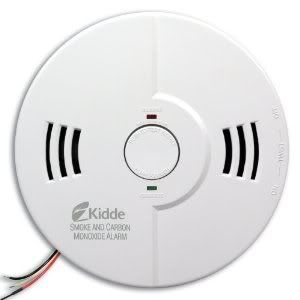
And now in changing the batteries in my apartment taught me something else that has really helped me in cooking (especially in a cast iron skillet or Dutch oven). Newer smoke detectors actually have a button on them that you can press to shut them off for 7-20 minutes, should they go off for the wrong reason, like when you burn your home made home fries or hash browns. See my other blog entry about cooking oil smoking points in the kitchen for more info. And, it also vocally tells you whether it detected a fire or carbon monoxide. In the OLD days, you had to get the chair under the detector, rip the cover off, and rip the battery out. In my 90s house, you had to stand under it and fan it with a newspaper until it stopped. In my new apartment, I just have to reach up and press a button for 5 seconds (and then I have 7-20 minutes to clear the smoke out of the kitchen). WOW!!! Massively helpful things to know when I'm burning dinner.

Another new technology about the 4 smoke detectors in my apartment, is that they are all tied together by the wires in the walls. If ONE goes off, they ALL go off. So, if a fire starts down the hall in my son's room, the detector in MY room goes off. I'm more likely to hear it in my own room, than down the hall in his, with both doors closed. Yeah, that is another good development in smoke detectors.

Something else that I learned in doing some basic research, is that it is still recommended that you change your batteries twice per year, but it is also now recommended that you change your smoke detectors every 10 years. I'm fortunate that my apartment complex was only built 5 years ago, but I still listen to grandpa twice a year.

So, bottom line, some suggestions:
Change your smoke detector batteries on the days that you change your clocks, so twice per year.
Change your smoke detectors themselves, every 10 years to keep up on technology.
  Wire them all together so if one goes off, they all will go off and you are more likely to hear it.
Watch what cooking oils used in the kitchen to prevent burnt dinner smoke (see the blog for more info)
Enhanced by Zemanta

Mar 28, 2012

Ties - A Dying Tradition

While they aren't as popular today as they used to be, I still feel that every man needs to know how to tie a tie. Face it, a man should wear a tie to a wedding, funeral, science fair, interview, and just because you should "dress for the job you want, not the one that you have." I was honored to learn it from my grandfather and recently had to pass that knowledge on to someone "in the next generation." LOL... yeah, that was an experience that I'll always have in my mind.

It wasn't until recently that I learned the "name" of the knot my grandfather taught me, as this website explains. It was the "Half Windsor Knot." Because of the Tie-a-Tie website, I've learned how many other ways that I can make my silk tie look good. But, I am now going to share with you a video that explains how to do it.


Yeah, I have to comment on my opinions about ties.  A key one is to AVOID the clip-on ones. Just take a little time to learn something in life, don't just take the path of least resistance.  This will serve you more later in life. I learned to tie a bow tie for my prom instead of just clipping it on. Some events in your life will always be in your mind if you PERSONALIZE them. Make them a memory, not just an action. I've also written a blog entry about How to Travel and Store A Tie.

Anyway... refer to the links above about ties, join me as a member, and check out the Art of Manliness link to the right as a reference about how to impress your date...

Mar 27, 2012

Sub / Hoagie / Grinder / Po' Boy Sandwiches

Shrimp po-boy sandwich, from Parkway Bakery, N...
Po'-boy, from Parkway Bakery, New Orleans.
(Photo credit: Wikipedia)
The other day I pulled into a TA truck stop to get gas. It was lunch time and I had some time to kill, so I decided to go in to browse and have lunch at Popeye's (since I hadn't eaten there yet). I stared at the menu and immediately decided that it was time to have my first po' boy. I ordered a spicy dressed fried chicken po' boy, Cajun fries and biscuit.

I had heard about them before, but I grew up in the Northeastern U.S., so I was brought up on "subs," " grinders," "hoagies," "Philly cheese steaks," "heroes," "zeps," "blimpies." Reading the history of a "po' boy" on the back of the wrapper is what led me to do a little surfing to find out what the "differences" were since they seemed the same to me. I will say, that having been to a Popeye's for a po' boy, I WILL be going there as often as possible.

The best explanations I am sharing come from Wikipedia for a Po' Boy and Submarine. I'm not going to bore you with all of the details. For more information, click on the links for each.

They all began appearing on menus in the late 1800s and early 1900s across the U.S. The Italian culture brought them to the Northeastern U.S., and Louisiana brought the po' boy around 1920 (due to a street car strike). Regardless of the "reasons" they are so yummy, I'm just glad that they exist. I have a pizzeria and a Subway less than a mile away. The only real difference is what is put on or in them and the spices used...

It also brings to mind a sandwich that I ate a lot of in Pittsburgh, PA from Primanti Bros.  The original location was in the Strip District, which is where a lot of things happened. The Primanti Bothers started in the 1930s to provide a meal for the produce truck drivers that needed a complete meal, all in one. They make their sandwiches with the main entree (steak, eggs), french fries, cole slaw, and tomatoes all between 2 slices of Italian bread. A trucker could make his delivery to the Strip, grab a meal, and be back on the road in no time. All for a decent price. Sigh...the memories of finding a place to eat after a long evening of being out... but I digress...

A key point that I learned from doing this surfing, is that if you are going to make your own sub / hoagie / po' boy, putting a layer of cheese on the bottom, then the meat, and then another layer of cheese helps prevent the bread from getting soggy...good to know. Maybe that is why a true Philly Cheese steak has so much cheese folded into it. Happy eating...
Enhanced by Zemanta

Mar 21, 2012

St. Patrick's Day Poem

St. Patrick's Day 2012 is a few days past us, but I would be remiss to not share a poem I came across on another website about the myths about that holiday [link] related to my Corned Beef & St. Patrick's Day post. Below is a poem written by Frances Shilliday that summarizes my entry. Frances was kind enough to grant me permission to publish it on my blog (yeah, I asked permission because as a writer, I can't morally cut & paste to plagiarize someone).


GOOD GRIEF - NOT BEEF!
 

I just want to put something straight
About what should be on your plate,
If it's corned beef you're makin'
You're sadly mistaken,
That isn't what Irishmen ate.

If you ever go over the pond
You'll find it's of bacon they're fond,
All crispy and fried,
With some cabbage beside,
And a big scoop of praties beyond.

Your average Pat was a peasant
Who could not afford beef or pheasant.
On the end of his fork
Was a bit of salt pork,
As a change from potatoes 'twas pleasant.
This custom the Yanks have invented,
Is an error they've never repented,
But bacon's the stuff
That all Irishmen scoff,
With fried cabbage it is supplemented.

So please get it right this St. Paddy's.
Don't feed this old beef to your daddies.
It may be much flasher,
But a simple old rasher,
Is what you should eat with your tatties.


Mar 13, 2012

Corned Beef & St. Patrick's Day

Corn beef hash including potatoes and carrot.
Corned Beef Hash breakfast via Wikipedia
Something that has been on my mind for a few decades, is why Irish-Americans gravitate to eating corned beef on St. Patrick's Day and drink a lot of green beer. Okay, I understand the green beer part, but I've always wondered about corned beef since I've never eaten it and have received a LOT of junk mail promoting it for breakfast and lunch on St. Patrick's Day. So, I am going to summarize based on these 3 key websites (and yes, this is my bibliography):

The name of corned beef most likely came about when meat was dry-cured with salt in Europe and the Middle East. The word "corn" derives from Old English which describes the meat being dry-cured in CORNS of salt. The pellets of salt were approximately the size of kernels of corn and were rubbed into the meat to keep it from spoiling.

Canned corned beef
Canned Corned Beef via Wikipedia
Irish corned beef was used and traded extensively from the 1600s to the mid 1800s for England and as provisions for the British naval fleets & North American armies due to its non-perishable nature. It was traded to the French for feeding the colonists and slaves in their Caribbean sugar plantations. Corned beef as a commodity started to die out in the mid 1800s when slavery was abolished but it did have a resurgence during World War II in the canned form. Makes me wonder about where Spam started.
During the Great Potato Famine, raising cattle to sustain the British Isle and Atlantic trade crowded out land in Ireland for other agricultural development and prevented the raising of crops to feed the local population. Which is why a ton of people from Ireland emigrated to the U.S. Because beef was less expensive than pork here, that is why the Irish immigrants substituted it in recipes on holidays.

Which leads me to my conclusion. According to all of the research & reading that I've been doing, corned beef on St. Patrick's Day is an Irish-American tradition, not a true Irish national tradition. That's why I haven't had it yet and why I'll be making a bacon joint instead...

Feb 10, 2012

Driving & Mirrors


I've made several entries about driving because I do a LOT of it, have been doing it for over 20 years, but love learning new things, and just want to share with you. Click the Driving Advice tab at the top to see some of my driving related entries. This one is about how to adjust your mirrors properly according to the Blindspot and Glare Elimination (BGE) settings to be able to drive more safely. Rather than re-write what has already been done, I am using the entry on the Driver's Ed Guru website as my reference. I'm summarizing that info here, but please do visit their website for more information about the BGE settings. Yeah, they even have a video you can watch...but I have it here too...

The Blindspot and Glare Elimination (BGE) mirror setting was developed in 1996 by a member of the Society of Automotive Engineers named George Platzer. The BGE setting reduces the usual two large blindspots to four mini blindzones. None of these four mini blindzones are large enough to completely hide a car.
There are several advantages to the BGE setting:
  • You no longer have to turn your head to look into the blindzones.
  • Only a brief glance at the side mirror and inside mirror is needed.
  • By glancing at the mirror, you keep the road ahead in your peripheral vision. Turning your head completely eliminates the road ahead from your field of vision.
  • Glare from the side mirrors is almost entirely eliminated. You should no longer have a trailing car’s headlights shine directly into your eyes.
This is how to set up the BGE setting:
  • Place your head against the driver’s side window and adjust the driver’s side mirror so you can barely see the driver’s side of your car.
  • Move your head as close to the center of the car as possible and adjust the passenger’s side mirror so you can barely see the passenger’s side of your car.
  • To check your BGE settings, watch as a car passes you in an adjacent lane. It should enter your outside mirror before it leaves the rearview (inside) mirror. Also, the car should appear in your peripheral vision before it leaves the outside mirror.
  • Remember, your inside rearview mirror is your primary mirror and it will take time to get accustomed to no longer seeing the sides of your car in the side mirrors.


As a personal note, I will ALWAYS use the shoulder look to confirm what I might see, even though their bullet point above says I don't have to. Sorry, been doing it for so long that I will still do it. But, employing this information means that I don't run the risk of sitting in a body shop any more than I need to...

Drive safe...

Jan 30, 2012

Night Driving II

This is the second entry I've made about driving at night (refer to Night Driving for a good start). But this one is based on a lot of driving I've done in the last few weeks on the highway and on local streets. The concepts are the same. And a key point that nearly EVERYONE has forgotten, is that driving is a PRIVILEGE, not a RIGHT. Which means, there are some basic things that every driver needs to be aware of to keep their license.

Headlight overkill on an Italian scooter.
Image via Wikipedia
My first point is about headlights. This is a follow up to another entry I made about asking people to understand when to use their headlights click [HERE]. In that entry, I ask drivers to please consider when they turn on their lights. Today I am going to ask drivers to be aware of some BASIC driving concepts about headlights.


If we are driving on hilly terrain, please don't flash me your high beams because sometimes our lights will be directly in each others' eyes simply because of where we are in relationship to each other. You flashing instantly blinds me for a few seconds, and there isn't much I can do about it, except flash you back, and blind you too. That isn't safe for either of us as we approach each other at ANY speed, let alone above 55 mph.

When driving on an interstate or highway, even if there is a grassy median between us, you going south when I'm going north, and you have high beams on, will still blind me, especially on hilly terrain or going around bends. Have you figured out why there are green posts on concrete medians when we are closer together? Yeah, your lights still blind me and make it unsafe for those around us no matter how much distance separates us if there are not hills, trees, or posts to break up your high beams.

 If you are driving in a coupe or sedan, and I am driving in a medium sized SUV (like the Toyota Highlander), do not flash me, you are riding lower than me so my lights are going to hit your eyes because YOU chose a lower body style to drive. Also applies to all of the people that lower the driver seat as low as possible or recline it back more.


LED headlights, world first on production cars...
Image via Wikipedia
Headlight technology is changing. Halogens are on the way out, while Xenon and LEDs are on the way in. If I spend money to get the best bulbs I can for my vehicle, don't assume that I am leaving my high beams on (I NEVER turn them on), it is just that my bulbs are brighter than yours. Again, flashing me will only blind me and make it temporary blind to my environments.

Flashing your headlights at me can be interpreted as "aggressive driving," and yes, you can be pulled over, ticketed, and fined for doing that in several states. I leave it to YOU to find out which ones.

Okay, enough ranting about headlights at night. How about my other two points related to turning. Even though that is a basic concept, a majority of drivers out there today never truly learned it, or they just don't care about others.

All vehicles come with 4 little lights on them (including motorcycles). 2 in the front and 2 in the back, 2 on the right, 2 on the left. They are all controlled by a little rod or button that sticks out of your steering column/handlebar, at your fingertips. The purpose is so I don't have to depend on my telepathic ability to figure out what the Hell you are going to do. How about actually USING them to let me know? Both during the day, and at especially at night.

That applies not only to when you are turning from one road onto another, it applies to most driving laws to when you are simply changing lanes on a multi lane road. Yeah, you should check your local BMV/DMV driving codes to see what is expected of you there. I've been pulled over & ticketed for failing to indicate a lane change. Why? Because I now understand how unsafe that is for those around me.


When did "drift turning" become acceptable? By this I mean when you approach an intersection, and don't make a legal 90 degree turn onto that road, but you drift across my turning lane and double yellow line (on the road you are entering) at a 45 degree angle, and give ME a dirty look because I was in the turning lane? Oh, right, it is either because you don't care or your stop light actually was RED when you were trying to skate drift through it to get to your destination 30 seconds earlier.


When did driving on a side street to make a turn at night, you, AS A DRIVER, need to be aware of what is going on around you. Just because you come to an intersection and can turn without a stop sign, you still need to use the turn signals, and be aware of what people and dogs may be walking in that area. Remember, pedestrians have the right of way, the driver does not. Using the turn signals indicates to the non-telepathic pedestrians that you intend to turn (so maybe they'll stop their steps to avoid being hit) AND you need to be aware of the fact that there may be pedestrians in your neighborhood that you really don't want to be held responsible for hitting. Because yes, it WOULD be your fault. This happened recently to some friends of mine and their 2 dogs. If the driver had hit them, I would have hunted them down and made them remember each and every moment of the suffering the caused, simply because they didn't use their turn signals and didn't pay attention to what was going on around them as a driver.

Okay, maybe that is enough of a rant. A better summary of this entry is that we are all facing a lot more distracted driving today. Please go back to the BASICS that we were all taught in driving classes about headlights, turning signals, turning, and awareness to make things safer again...oh yeah, and learn what the LAWS of driving actually are in your area...